Why Bitcoin Now Moves With Wall Street and Interest Rates

Hello, this is Treasurer.
Bitcoin briefly climbed back above $80,000 in August before retreating to the high-$70,000 range, continuing its recent volatility.
What has changed is not just the price, but what drives it.
In the past, Bitcoin was often viewed mainly through retail investor sentiment and crypto-market supply and demand. Today, investors also need to watch U.S. interest rates, Treasury yields, spot Bitcoin ETF flows, corporate Bitcoin purchases, and government regulation.
Wall Street is shorthand for the traditional financial institutions that manage large pools of capital: asset managers, investment banks, and hedge funds.
Saying that Bitcoin is now connected to Wall Street means that a meaningful share of Bitcoin demand now originates from their allocation decisions.
And when these institutions decide where to put capital, the first variable they look at is interest rates. That is why Bitcoin now has to be read alongside interest rates and Wall Street at the same time.
Bitcoin can now be accessed through traditional brokerage accounts.

Source: 한국경제
One of the biggest structural changes has been the introduction of spot Bitcoin ETFs.
In January 2024, the U.S. Securities and Exchange Commission approved spot Bitcoin exchange-traded products, allowing investors to gain Bitcoin exposure through conventional brokerage accounts without directly holding the asset.
This created a new channel for asset managers and institutional investors to enter the market.
From mid-August to early September, U.S. spot Bitcoin ETFs recorded approximately $3.8 billion in net inflows over three consecutive weeks.
As a result, ETF flows have become an increasingly important measure of Bitcoin demand.
The market is no longer shaped only by activity on crypto exchanges. Investors now also watch how much institutional capital is entering or leaving through ETFs.
Companies are increasingly treating Bitcoin as a treasury asset.
Source: 매일경제
The profile of Bitcoin buyers has also changed.
A leading example is Strategy, formerly MicroStrategy.
The company has repeatedly raised capital through equity and preferred securities and used part of the proceeds to acquire more Bitcoin.
As of September 7, Strategy held approximately 845,000 Bitcoin.
What matters is not simply the size of its holdings.
Strategy has created a structure in which capital raised in traditional financial markets can translate into additional Bitcoin demand.
Bitcoin prices can affect Strategy's valuation, while the company's financing and purchasing decisions can, in turn, become relevant to the Bitcoin market.
The boundary between crypto markets and traditional capital markets is becoming increasingly blurred.
Governments are also changing the way they approach Bitcoin.
Source: 중앙일보
The shift is not limited to private investors.
In March 2025, the U.S. government established a Strategic Bitcoin Reserve, primarily using Bitcoin already held by the government through criminal and civil forfeitures.
Bitcoin placed in the reserve is generally intended to be held rather than sold.
In May 2026, the American Reserve Modernization Act was also introduced in Congress, seeking to put parts of this framework into law.
At the same time, policymakers are working to clarify the rules governing digital assets.
The CLARITY Act, which aims to define digital assets more clearly and clarify the responsibilities of U.S. regulators, has become another major issue for the market.
For investors, the key question is therefore not only whether governments hold Bitcoin.
It is also under what regulatory framework institutional investors will be able to participate in the market.
Bitcoin cannot escape interest rates.
Source: 한겨레
Bitcoin is often described as “digital gold,” but its price remains highly sensitive to interest rates and liquidity.
When interest rates rise, relatively safer assets such as government bonds and deposits offer more attractive returns. That can reduce the relative appeal of highly volatile assets such as Bitcoin.
This relationship has become particularly important as Bitcoin becomes more integrated with institutional portfolios.
Monetary policy in Japan can also matter.
If Japanese interest rates rise, the economics of the yen carry trade—borrowing cheaply in yen and investing in higher-return assets elsewhere—become less attractive.
If investors unwind these positions and reduce risk exposure, Bitcoin can be affected alongside equities and other risk assets.
Growing institutional participation therefore does not necessarily make Bitcoin independent of traditional markets.
In many ways, it makes Bitcoin more closely connected to the Fed, bond yields, currencies, and global liquidity conditions.
Institutional adoption does not mean lower volatility.
Source: 인베스트조선
The arrival of ETFs and institutional investors does not automatically make Bitcoin a stable asset.
ETFs are a channel for capital to enter the market—but they are also a channel for capital to leave.
When risk appetite is strong, large inflows can support prices. When financial conditions tighten or investors become more cautious, the same mechanism can accelerate outflows.
Rather than saying that institutional participation has stabilized Bitcoin, it is more accurate to say that the forces driving Bitcoin prices have expanded beyond the crypto market itself.
Global capital flows now matter more than ever.
Not every Bitcoin-related company has the same exposure.
Source: 한경매거진
When Bitcoin moves sharply, listed companies associated with digital assets often move with it.
But their business models are very different.
- Strategy is primarily exposed through its Bitcoin holdings and financing strategy.
- Coinbase earns revenue from crypto trading, custody, and other digital-asset services.
- Robinhood also offers crypto trading, but its business extends across equities, options, and other financial services.
So the more useful question is not:
“Which stock rises when Bitcoin rises?”
It is:
“How does growth in the Bitcoin market actually translate into this company's revenue and earnings?”
AlphaLenz looks beyond Bitcoin's price to the companies behind the market.
Bitcoin's price can tell us where the market is moving, but it does not explain how that movement affects individual companies.
With AlphaLenz, investors can compare the business models, financial results, filings, and recent developments of companies such as Strategy, Coinbase, and Robinhood.
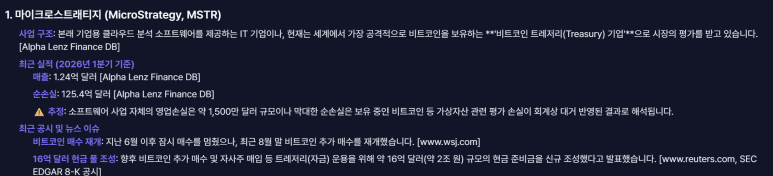
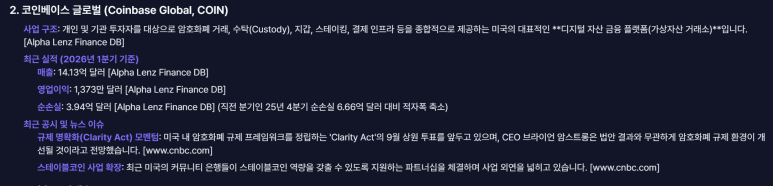
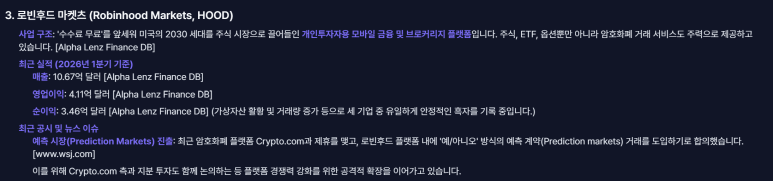
[AlphaLenz – Comparison of Bitcoin-Related Listed Companies]
Even within the same Bitcoin ecosystem, the earnings drivers are different:
- Strategy is primarily linked to Bitcoin holdings and capital raising,
- Coinbase to trading, custody, and digital-asset services,
- Robinhood to crypto trading activity within a broader financial platform.
Rather than grouping them all under the label of “Bitcoin-related stocks,” investors need to understand how each company is economically exposed to the growth of the crypto market.
Bitcoin is still a digital asset.
But the investors buying it, the channels through which capital enters the market, and the rules governing it have changed significantly.
Today, understanding Bitcoin requires more than watching the price chart.
It also means understanding who is buying, where the capital is coming from, and how interest rates and policy are shaping those flows.