How Diversified Is Your Portfolio in the AI Era?
 Hello, this is Treasurer.
Earlier this year, the Los Angeles County Employees Retirement Association (LACERA), which manages roughly KRW 131 trillion in retirement assets, was asked a simple question:
“How much of our portfolio is exposed to AI?”
Its estimate came back at 8% to 19%.
For an institution managing such a large portfolio, that is a surprisingly wide range. The reason is simple: there is still no universal definition of what counts as an AI-related investment.
But the issue goes beyond measurement.
Even when a portfolio is spread across equities, bonds, private markets, and other asset classes, many of those investments may still be tied to the same underlying AI growth cycle.
So a portfolio can look diversified on the surface while remaining exposed to the same source of risk.
Diversification is not just about owning more assets.

Source: 웰스매니지먼트
Diversification is often explained with the phrase, “Don’t put all your eggs in one basket.”
The idea is to spread capital across different assets so that weakness in one area can be offset by strength elsewhere.
But there is an important condition:
Those assets need to respond to different economic forces.
For example, splitting a portfolio equally between Samsung Electronics and SK hynix increases the number of holdings, but both companies remain heavily exposed to the semiconductor cycle.
If the semiconductor industry weakens, both can be affected at the same time.
The portfolio may contain more names, but the underlying risk has not necessarily been diversified.
Different asset classes are increasingly connected by the same AI theme.

Source: IBM
Imagine owning ten different businesses in one neighborhood: a cafe, a salon, a restaurant, and a stationery shop.
They appear diversified.
But if all ten depend on employees from the same nearby factory, the closure of that factory could hurt every business at once.
A similar concern is emerging in financial markets.
Bloomberg has reported that AI-related exposure now accounts for a significant share of several major asset classes. Estimates cited in the report include:
- Around 40% of the S&P 500’s market capitalization
- Roughly 49% of investment-grade corporate bond issuance
- Approximately 87% of venture capital investment
Equities, bonds, and venture investments are very different products. But all three may ultimately depend on the same AI investment cycle.
Alphabet offers a simple example.
Buying Alphabet shares makes you a shareholder. Buying its bonds makes you a creditor. Investing in data-center infrastructure used by Alphabet appears to add another asset class.
Yet all three investments can still be affected by the same underlying factor: continued spending on AI infrastructure.
Different baskets do not necessarily mean different risks.
When the underlying theme is the same, stocks and bonds can move together.
Source: 피델리티자산운용
Bonds are often expected to provide some protection when equities come under pressure.
But that relationship can weaken when both assets are exposed to the same fundamental risk.
In July, concerns grew over whether massive AI spending could continue to justify elevated technology valuations. Semiconductor stocks came under pressure, while bonds issued by some large technology companies also weakened.
Although equities and bonds are different asset classes, both were affected by concerns surrounding AI capital expenditure and its potential returns.
That is why large institutional investors are increasingly reviewing how much AI exposure they actually carry.
For them, AI represents both a major growth opportunity and a potential source of concentration risk.
AI exposure depends on how you define AI.
Source: 모두의연구소
This brings us back to LACERA’s 8%–19% estimate.
The range is wide because there is no single standard for deciding what qualifies as an AI-related company.
A semiconductor company producing AI chips is relatively easy to classify.
But what about a utility supplying power to data centers?
Or a retailer using AI to improve logistics?
The answer changes depending on where the boundary is drawn.
That is why estimates can vary significantly. Goldman Sachs has estimated that AI-related companies represent around 40% of the S&P 500, while a JPMorgan estimate put the figure closer to 57%.
The difference does not necessarily mean one calculation is wrong. It reflects different definitions of AI exposure.
Institutional investors are now developing their own frameworks to address this problem, including tools designed to measure how sensitive portfolio companies are to the growth of AI.
Reducing AI exposure is not an easy answer either.
 Source: 조선일보
If too much of a portfolio is tied to AI, reducing that exposure may seem like the obvious solution.
But AI has also been one of the strongest drivers of market returns.
Bloomberg Intelligence’s global AI-related equity index has outperformed the broader market by roughly 11 percentage points per year over the past two years.
Reducing exposure may lower concentration risk, but it can also mean giving up participation in one of the market’s strongest growth themes.
The real question is therefore not simply:
“Should we own AI?”
but
“At what point does AI exposure shift from opportunity to excessive concentration?”
Owning an ETF does not mean you are safe from AI exposure.
출처: 인베스트조선
This issue is not limited to large pension funds.
A broad U.S. equity ETF already contains significant exposure to major technology and semiconductor companies.
If an investor then adds a semiconductor ETF or an AI-themed ETF, the products may look different in the account, while many of the underlying holdings overlap.
In other words, several ETFs can still produce repeated exposure to the same companies and the same investment theme.
What matters is how each company is actually exposed to AI.
Even companies grouped under the same AI theme can have very different business models.
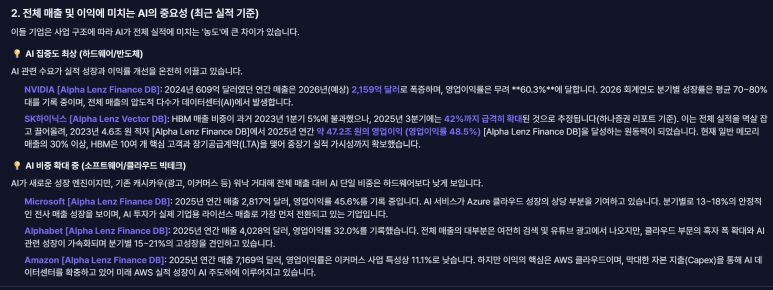
Using AlphaLenz, investors can compare companies such as NVIDIA, SK hynix, Microsoft, Alphabet, and Amazon based on how AI contributes to their businesses.
NVIDIA is primarily connected through GPUs, SK hynix through HBM, Microsoft and Alphabet through cloud and AI services, and Amazon through AWS and AI infrastructure.
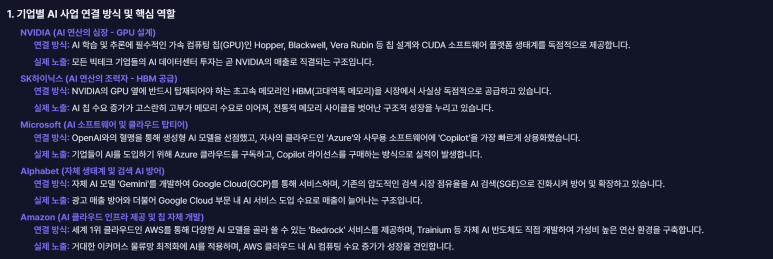
[AlphaLenz – Comparison of AI business exposure]
But the connection itself is only part of the story.
The importance of AI to revenue and earnings also differs by company.
For NVIDIA and SK hynix, AI infrastructure demand has a relatively direct impact on business performance. For Microsoft, Alphabet, and Amazon, AI is becoming an increasingly important growth driver within much larger cloud, advertising, and platform businesses.
So rather than simply counting how many AI-related stocks are in a portfolio, investors need to understand how each company is exposed to AI, how direct that exposure is, and how much it actually matters to revenue and earnings.
Diversification still matters.
But in an AI-driven market, owning more assets does not automatically mean owning different risks.