Why an Insurance AI Error Never Ends with Just One

2026.07.31

Why You Need a System to "Recall" Bad Decisions

Hello, this is Treasurer.

Let's say an insurance company used AI to review thousands of insurance claims.

One day, it turns out the AI had been misreading a specific disease code all along. The company fixes the error and updates the system with corrected criteria.

So is the problem solved?

Claims filed from now on will follow the corrected criteria but the outcomes of claims already processed remain unchanged. There may be more customers out there whose payouts were reduced or denied because of the same error.

An insurance AI's mistake rarely ends with a single bad decision.

Because the same model and criteria are applied repeatedly across many contracts, one error can spread the same way to a large number of policyholders.

You need a system that can trace how far a faulty judgment has already been applied and go back and review the decisions that were already made.

Today, we'll look at a new standard for trustworthy insurance AI: judgment recall.


Human Mistakes and AI Errors Spread Differently

Source: iStock

A caseworker missing a document or misreading a date is usually an isolated mistake tied to one specific case. AI or automated rule errors are different — they can rapidly repeat across every case where the same condition applies.

Once a flawed condition is written into a review rule, the same wrong judgment keeps getting applied to the same type of claim:

  • Misclassifying a specific disease code as a different condition
  • Errors in how coverage start dates are calculated
  • Repeatedly misreading date formats in scanned documents
  • Applying the current policy terms to a contract that should follow an older version

If an error like this was used across 1,000 reviews, all 1,000 may need to be checked again.

And even after the model or rule is fixed, that fix only ensures future claims are processed correctly. Unless someone goes back and looks, the outcomes for customers reviewed before the fix stay exactly as wrong as they were.

The risk with insurance AI isn't that it can be wrong. It's that it can keep being wrong in the same way, over and over.


Insurance Needs "Judgment Recalls," Too

Source: Modulabs

When a defect is found in a car or an electronic device, the manufacturer issues a recall. They don't just fix newly manufactured units, they identify every previously sold unit affected by the same defect and repair or replace it.

They don't wait for customers to discover the problem and report it themselves. The company identifies the scope of the defect and reaches out to affected customers directly. Insurance AI needs the same concept.

When an error is discovered, insurers need to go back and re-examine past review decisions that may have been affected by it — a process we can call a judgment recall.

For example, insurers can identify cases for re-review using conditions like:

  • Reviews conducted using the same AI model version
  • Claims where the same denial reason was applied
  • Claims involving the same disease code or incident type
  • Contracts using a specific policy version
  • Cases where the same document-recognition rule was applied
  • Reviews processed during the period an error is suspected to have occurred

If re-review confirms that a decision was in fact wrong, this should be followed by additional payment, correction of the review outcome, and notification to the customer.

The key is not waiting for the customer to discover the problem and file a complaint themselves.

An individual customer has no way of knowing whether their review outcome was caused by an AI error, let alone whether the same issue affected other customers. The insurer, on the other hand, can identify which systems and criteria were applied across multiple claims. That's exactly why the responsibility to find recurring errors and correct past outcomes has to rest with the company operating the system.


To Correct a Judgment, You First Need to Know Why It Was Made

출처: Keysight

Reviewing a flawed decision takes more than just storing the final outcome.

You need to know which documents and figures were used, and under what conditions and criteria the conclusion was reached. Otherwise there's no way to examine the cause of the error or trace the reasoning behind the judgment.

The same is true in investment analysis. Even the same conclusion about a stock carries a different meaning depending on which filings, news, and financial figures it was based on.

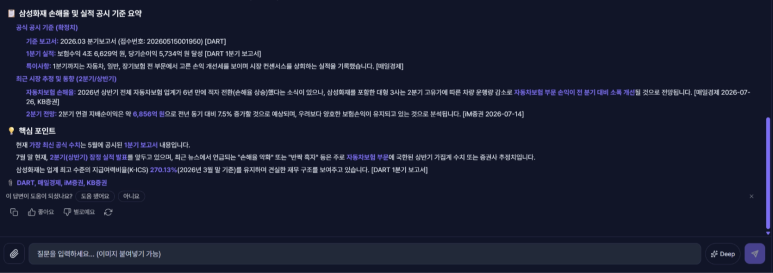
AlphaLenz cross-checks every output against the original filings and source documents, presenting figures alongside their supporting evidence. When the evidence isn't sufficient, it limits its own inference and is designed not to force an answer it can't actually verify.

This isn't just a mechanism for improving AI accuracy. It's also the foundation that makes it possible to trace exactly which information and reasoning need to be re-examined when a problem turns up later.

Trusting an AI's conclusion can't stop at receiving the answer. You need to be able to go back and see where that judgment started, and what evidence it passed through along the way.


A Good Insurance AI Isn't One That Never Makes Mistakes

Source: HDFC Life

Improving the accuracy of insurance AI still matters. But it's unrealistic to expect an AI used in real operations to never make a single mistake. Products and policy terms keep changing, and new forms of documents and claims keep showing up that the system has never seen before.

What insurers need to prepare for isn't the expectation of a flawless AI. It's a structure that can catch errors quickly, stop them from spreading further, and find and correct every past decision affected by the same mistake.

Fixing the AI isn't enough. You have to be able to fix what the AI already produced.

The real responsibility of insurance AI doesn't end with explaining a single decision. It means confirming how far a wrong judgment spread, and following through until every affected customer's outcome has been recalled and corrected. That's the next step insurance AI has to take if it wants to earn trust; beyond just speed and automation.

Why an Insurance AI Error Never Ends with Just One | 트레져러