
Why 80% of AI Projects Stall at the PoC Stage | Financial AX Beyond Validation

Hello, this is Treasurer.
Over the past few years, generative AI has become one of the defining topics in the financial industry.
Financial institutions around the world are actively exploring AI across a wide range of functions, including workflow automation, investment research, risk management, and customer service. As a result, many organizations have launched Proof of Concept (PoC) projects to evaluate AI's potential.
However, despite the growing number of AI adoption announcements, examples of AI fundamentally transforming day-to-day operations remain relatively limited.
Many organizations successfully complete their PoC initiatives but fail to scale them into enterprise-wide deployment. Even after implementation, employees often continue relying on traditional workflows instead of integrating AI into their daily operations.
So why does this keep happening?
The answer is that while most AI projects succeed in validating the technology itself, they often fail to drive meaningful changes in real business processes.
What Is a Proof of Concept (PoC)?

A Proof of Concept (PoC) is the stage where organizations validate whether a specific technology can be effectively applied in a real business environment.
Although PoC is often confused with a demo or a pilot project, each serves a distinct purpose and plays a different role in the adoption process.
Demo: Demonstrates what the technology can do.
Proof of Concept (PoC): Validates whether the technology can be applied to real business
workflows.
Pilot: Tests the solution in a limited production environment before full-scale deployment.
In other words, a PoC isn't about asking, "Can AI do this?"
It's about answering, "Can AI create real value within our organization's workflows?"
Why PoC Matters in Financial AX

*Source: PwC
Compared to most other industries,
adopting AI in financial services is significantly more complex.
Financial institutions operate under strict security requirements for personal and financial data
while also complying with extensive regulations and internal governance frameworks.
In addition, financial AI is expected to do much more than simply generate results.
It must provide explainability, auditability, and accountability, all of which are essential in a
highly regulated industry.
For example, when AI is used to generate investment reports or support insurance underwriting, accuracy alone is not enough.
Organizations must also consider who reviews the output, how errors are tracked, and how
AI integrates with existing business processes.
For this reason, the real challenge in financial services is not whether AI can produce accurate
results. It is whether AI can be safely and effectively integrated into real business workflows.
Common Reasons Financial AX PoCs Fail
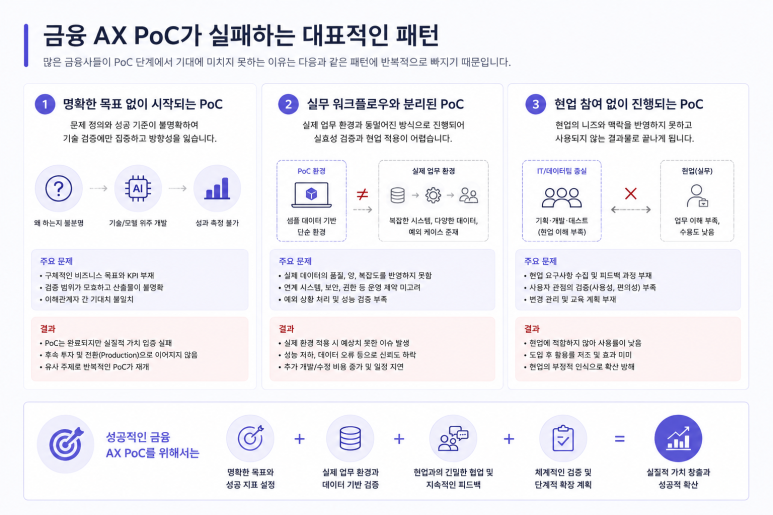
1. Starting a PoC Without Clear Objectives
This has become one of the most common patterns since the rise of generative AI.
"Our competitors are adopting AI, so we should do the same."
It is a familiar mindset, but projects that begin this way rarely deliver meaningful business
outcomes.
A PoC is not a project designed to validate technology for its own sake. It is a project designed to solve a specific business problem.
That is why organizations need clear answers to the following questions before a PoC even
begins.
What problem are we trying to solve?
Which KPIs are we trying to improve?
How will success be measured?
Without clearly defined objectives, it becomes difficult to determine whether a PoC has actually
succeeded.
2. A PoC That Is Disconnected from Real Workflows
Many AI PoCs succeed from a technical perspective but never gain adoption in day to day
operations.
For example, an AI system may be capable of generating reports automatically. However, if employees still need to log into a separate system and manually copy and paste the output,
the improvement in productivity will be limited.
Successful Financial AX depends less on the AI capability itself and more on how seamlessly it integrates into existing business workflows.
A PoC that remains disconnected from operational processes is unlikely to progress beyond the demonstration stage.
3. A PoC Without Business User Participation
It is natural for AI initiatives to be led by IT teams.
However, when business users and operational teams are not actively involved, the validation
process can become disconnected from real world business needs.
Technical success does not necessarily translate into business success.
Meaningful validation is only possible when the people who perform the work every day are
involved from the very beginning of the project.
What Successful PoCs Have in Common
Projects that successfully move beyond the PoC stage and into production tend to share several common characteristics.
First, they have a clearly defined scope.
Rather than attempting to transform the entire organization, they begin with a single, well defined business process where AI can deliver measurable value.
Second, they establish measurable success criteria.
Organizations measure baseline metrics such as processing time, error rates, and labor hours
before deployment, then quantitatively evaluate the improvements after implementation.
Third, business users are actively involved.
The people who use the solution every day participate throughout the validation process, provide continuous feedback, and help shape AI enabled workflows.
In the financial industry, PoCs often begin with use cases such as the following.
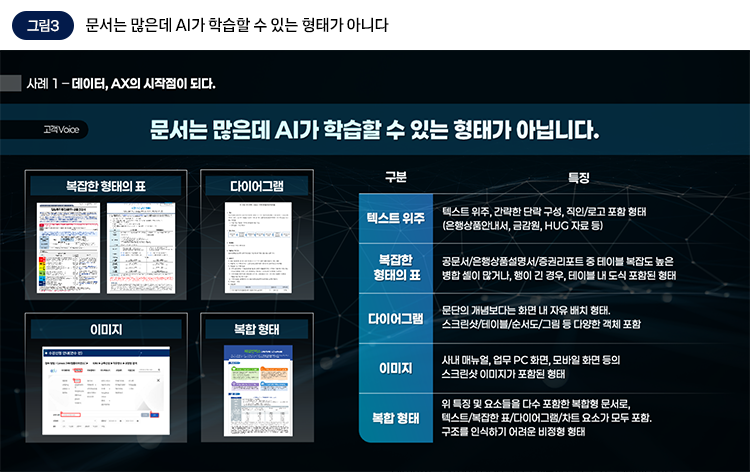
*Source: KT Enterprise
- Investment and research report summarization
- Contract and document classification
- Email draft generation
- Risk analysis support
- Internal knowledge search and question answering
- Underwriting and review support
These use cases involve highly repetitive tasks and produce measurable outcomes, making them ideal for validating the business value of AI before broader deployment.
The Goal of a PoC Is Transformation, Not Validation

In summary, the most important goal of a PoC is not to prove that AI can perform a specific task. It is to determine whether AI can drive meaningful changes in the way people work.
Ultimately, the success of Financial AX is not determined by model performance alone.
What matters most is how well AI understands business context, how seamlessly it integrates
with existing systems, and whether it can be adopted naturally by the people who use it every day.
That is the difference between a project that simply validates technology and one that delivers
real business impact.
Considering Financial AX?
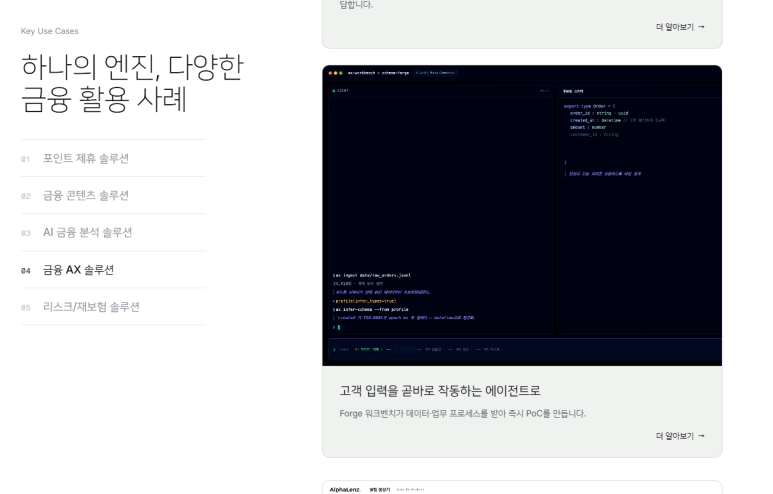
At Treasurer, we have built a financial AI infrastructure by collecting, refining, and structuring
proprietary financial data.
Today, we work with organizations across a wide range of financial sectors, including reinsurance, venture capital, and financial media. Our Financial AX projects are designed not only to
validate AI technology but also to deliver meaningful improvements to real business processes.
If you are exploring AI adoption or wondering where to begin your first PoC, we would be happy
to help you identify the right starting point and discuss your goals.

Financial AX and PoC Inquiries
📩 contact@treasurer.co.kr
🌐 treasurer.co.kr
The success of a PoC depends less on the technology itself and more on choosing the right
business problem to solve.
If you're looking for an AI adoption strategy tailored to the financial industry, we'd love to explore how Treasurer can help.