The First Department to Change in the AX Era
Hello from Treasurer.
Generative AI has quickly become one of the defining priorities for businesses worldwide. While companies across industries have rushed to adopt AI, the conversation has shifted beyond simply using AI. Today, the real challenge is how to integrate AI into day-to-day operations and turn it into measurable business value.
Many organizations have already completed AI proof-of-concept (PoC) projects, but not every initiative has translated into lasting success. Running a pilot is one thing; fundamentally changing how an organization operates is another.
This is precisely why AX (AI Transformation) has emerged as one of the most important concepts in enterprise AI.
AX is more than adopting AI tools. It is the process of redesigning business workflows, decision-making, and operational processes with AI at the core. Rather than treating AI as a standalone technology, AX redefines how organizations work from the ground up.
So where does AX begin inside an enterprise? Which departments are leading this transformation? And why are so many global organizations investing first in AI-powered research and decision intelligence?
In this article, we'll explore the business functions evolving fastest in the AX era and examine how AI-driven financial research platforms like AlphaLenz are helping enterprises transform the way they analyze information, make decisions, and create value.
The First Team AI Will Transform Isn't Engineering
Source: FreeGen News
When people think about AI adoption, they often assume that engineering or data science teams are the first to embrace it.
In reality, however, the earliest adopters within enterprises tend to be different.
More often than not, AI is first deployed in teams responsible for reading information, analyzing data, and supporting decision-making.
These typically include:
- Strategy
- Research
- Finance
- Investment
- Legal
- Marketing
- Customer Support
What these functions have in common is simple.
Every day, they process enormous volumes of information, organize and compare data, and ultimately make decisions based on their findings.
Their work depends less on producing information and more on transforming vast amounts of data into actionable insights. This makes them some of the earliest and most impactful beneficiaries of AI transformation.
The Real Challenge Isn't a Lack of Data
Many people assume that companies struggle because they don't have enough data.
In reality, the opposite is true.
Today's enterprises already have access to more data than ever before.
News articles
Regulatory filings
Earnings reports
Earnings calls
Industry reports
Market data
Government policies
Social media
Customer data
.
.
.
The problem isn't data scarcity—it's data overload.
Organizations are surrounded by an overwhelming volume of information. The real challenge is identifying what matters, connecting the dots, and turning raw data into timely, actionable insights that support better decisions.
Source: FineReport
The challenge isn't collecting more data—it's finding the right information, connecting it, and interpreting it at the right time.
Consider the task of analyzing a single semiconductor company.
An analyst may review dozens of news articles in a single day, examine regulatory filings, compare competitors' earnings, and study industry reports.
On top of that, they must monitor exchange rates, interest rates, memory chip prices, and supply chain developments—all of which can significantly influence the company's performance.
It's not uncommon for a comprehensive analysis of just one company to require reviewing hundreds of pages of information.
This is where AI delivers its greatest value.
Rather than replacing human expertise, AI dramatically accelerates the research process by searching vast amounts of information, summarizing key insights, and connecting data from multiple sources. As a result, professionals can spend less time gathering information and more time making informed, strategic decisions.
AX Is About Faster Decisions, Not Just Automation
Source: Britannica
Many people think of AI primarily as an automation tool.
But automation isn't what businesses are truly investing in.
What organizations really want is:
- Faster report generation
- More accurate market analysis
- Earlier risk detection
- Better and faster decision-making
AI is simply the means to achieve those outcomes.
In other words, companies aren't buying AI itself—they're investing in faster, higher-quality decision-making.
This is one of the fundamental differences between Digital Transformation (DX) and AI Transformation (AX).
DX focused on digitizing business processes.
AX goes a step further by redesigning how work gets done. AI takes over repetitive tasks such as searching, organizing, and processing information, allowing people to focus on what they do best: interpreting insights, making strategic decisions, and creating business value.
Why Global Financial Institutions Moved First
This shift is particularly evident in the financial services industry.
Finance is one of the most information-intensive sectors in the world.
Success depends on the ability to quickly understand and interpret enormous volumes of information—from corporate disclosures and earnings reports to macroeconomic indicators, interest rates, exchange rates, policy changes, and industry news.
As a result, global financial institutions have been among the earliest adopters of generative AI.
By integrating AI into research and investment workflows, these organizations are accelerating information analysis, improving decision quality, and enabling professionals to respond to market changes faster than ever before.
Source: Reuters
Morgan Stanley has deployed AskResearchGPT, an OpenAI-powered platform that enables financial advisors and analysts to quickly search and summarize insights from more than 70,000 proprietary research reports.
The firm has also expanded generative AI across its Wealth Management division. AI now helps advisors summarize client meetings, capture key discussion points, and generate follow-up email drafts—reducing administrative work while allowing them to focus more on client relationships and strategic advice.
These initiatives illustrate how leading financial institutions are using generative AI not simply to automate routine tasks, but to accelerate research, enhance productivity, and improve the speed and quality of decision-making.

Source: Daily Hong Kong
JPMorgan is also expanding the use of generative AI across its organization. The firm's internal AI platform assists employees with drafting documents, conducting research, organizing ideas, and streamlining knowledge work.
What's particularly notable is that these institutions did not adopt AI to replace analysts.
Instead, AI is reducing the time spent searching for, collecting, and organizing information, allowing analysts to devote more of their time to what matters most: evaluating opportunities, making investment decisions, and developing strategic insights.
This reflects a broader shift taking place across the financial industry. The role of AI is not to replace human expertise, but to augment it—handling information-intensive tasks so professionals can focus on judgment, critical thinking, and high-value decision-making.
Why So Many AI PoCs Fail

Source: Xpert.Digital
Following the surge of interest in generative AI, organizations across industries launched countless AI proof-of-concept (PoC) initiatives.
However, a successful PoC does not necessarily translate into a successful AI Transformation (AX).
Many AI projects fail to gain traction in day-to-day operations for remarkably similar reasons:
- AI is added on top of existing workflows without redesigning the underlying business processes.
- Data quality, governance, and management frameworks are not sufficiently mature.
- Security, compliance, and regulatory requirements are overlooked during implementation.
- Employees are given AI tools without clear incentives or practical reasons to incorporate them into their daily work.
Ultimately, AX is not about deploying another AI model. It is about redesigning how an organization operates.
McKinsey has similarly found that while most companies are investing in AI, only a small minority have reached a level of organizational maturity where AI is fully integrated into core business processes and consistently delivers measurable business value.
In other words, the greatest challenge is not the technology itself—it is organizational transformation.
AI Is Replacing Tasks, Not Jobs
Will AI replace financial analysts?
Will AI replace marketers?
These may not be the right questions to ask.
A more important question is:
Which tasks will AI take over?
Generative AI is exceptionally effective at reducing the time spent on repetitive, information-intensive work—such as research, document summarization, note organization, and drafting first versions of reports or presentations.
As AI takes over these routine tasks, the role of professionals shifts toward work that requires human judgment.
People will spend more time:
- Interpreting market dynamics and business context
- Assessing risks and opportunities
- Developing strategic recommendations
- Making critical business and investment decisions
In other words, AI is not replacing professions—it is reshaping how work is distributed within them.
The real impact of AI is not the elimination of jobs, but the reallocation of human effort toward higher-value activities where experience, creativity, and judgment matter most.
The Competitive Advantage Is Faster Decision-Making
The goal of AI Transformation (AX) is not to deploy more AI.
The real objective is to build an organization that can make better decisions—faster.
In the years ahead, competitive advantage will no longer be determined by how much data a company possesses. Instead, it will depend on how quickly that data can be transformed into actionable insights.
Organizations that can rapidly identify what matters, interpret information in context, and act with confidence will be better positioned to respond to changing markets and seize new opportunities.
Ultimately, the companies that lead the AI era will not be those with the most AI tools, but those that have successfully integrated AI into the way they think, decide, and operate.


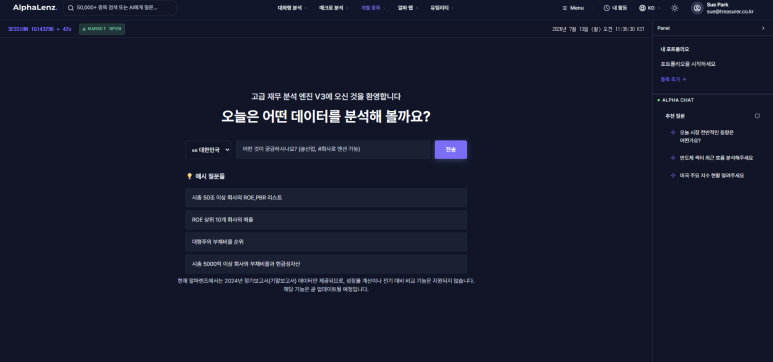
Throughout this transformation, AlphaLenz, an AI-powered financial research platform, helps analysts and investors connect vast amounts of financial information, uncover meaningful insights, and focus on higher-value decisions rather than time-consuming information gathering.
AI is not designed to replace people.
Its purpose is to help people make better decisions.
In the era of AI Transformation, the first departments to change are not engineering teams—they are the functions where critical decisions are made.
The future of research lies in combining the speed and scale of AI with human expertise and judgment. That is the vision behind AlphaLenz: empowering professionals to spend less time searching for information and more time generating insights, making strategic decisions, and creating lasting business value.