Why Financial AI Has to Start With Domain Ontology
 AI is rapidly expanding its role across the financial industry.
Summarizing documents, drafting emails, and analyzing massive volumes of data
are transformations many companies are already experiencing firsthand.
But one question remains in practice.
Does AI actually understand the work?
In a field like reinsurance, where technical terminology
and complex decision-making are deeply intertwined,
generating well-formed sentences is not enough on its own.
The same term can carry different meanings depending on context,
and decisions often require weighing past transaction history, market conventions,
and even the tendencies of the people involved.
Today, we take a closer look at why domain ontology is essential for AI
to truly understand reinsurance work, and how ontology shapes the performance of AI
built specifically for finance.
Why Financial AI Has to Start With Domain Ontology

Source: Herald Business
So what actually goes wrong on the ground?
Say a reinsurance broker takes a slip received from the London market
and feeds it into a general-purpose AI chatbot with a simple prompt:
"Summarize the key underwriting terms in this slip."
The output looks clean.
The sentences read naturally, and at first glance nothing seems off.
But anyone with real market experience would notice the problem almost immediately.
The AI read the words, but it never understood the context.
For example, it can explain why a particular marine cargo risk was structured as Excess of Loss. What it can't do is connect that to which reinsurers actually favor that kind of risk,
or what terms were applied in similar past deals.
It might even recommend a reinsurer as a strong candidate for a risk
that carrier actively avoids in practice.
The chatbot isn't wrong, exactly.
The issue is that it doesn't understand what these concepts mean within the reinsurance market,
or the web of relationships they operate in.
This is exactly where general-purpose AI and finance-specific AI diverge.
And the core technology that closes that gap is domain ontology.
What Is Ontology — Mapping an Expert's Mental Model

Ontology originated as a philosophical concept, but in AI
and information engineering it refers to a structured knowledge system
that maps out the concepts and relationships within a specific domain.
Put simply, it's the mental map inside the head of a reinsurance professional
with 20 years of experience, turned into a data structure.
A seasoned reinsurance broker looking at a single slip naturally makes connections like these:
Risk Type (Marine Cargo)
├─ Past Claims History
├─ Preferred Reinsurer List
│ ├─ Current Underwriting Capacity
│ └─ Recent Underwriting Strategy
└─ Assigned Underwriter
└─ Past Communication History
└─ Appropriate Sales Approach
Ontology represents these connections as a data structure.
While general-purpose AI reasons based on statistical patterns between words,
ontology-based AI reasons by following the actual web of business relationships.
How Is a Reinsurance Domain Ontology Built?

A reinsurance-specific ontology is typically built across four layers.
① Concept Layer
Defines the core concepts and terminology of reinsurance work, including parent concepts,
sub-concepts, related concepts, and opposing concepts.
For instance, under "reinsurance structure,"
Proportional and Non-Proportional reinsurance are defined, each linked to the risk types they suit.
② Relationship Layer
Defines the connections between concepts.
A specific risk, a specific reinsurer, the assigned underwriter, related emails,
and past transaction history are all linked into a single relationship network.
The more structured these relationships become, the more the AI can perform context-based reasoning instead of simple search.
③ Rule Layer
Encodes the judgment criteria that experienced practitioners rely on.
Examples of rules that might be included:
- Propose certain risk types to certain markets first
- Begin pre-review 60 days before renewal
- Exclude certain reinsurers under certain conditions
- Offer risks above a certain size to multiple markets simultaneously
This is the layer that turns judgment accumulated through experience into
something the AI can actually use.
④ Data Layer
This is where the ontology connects to real operational data.
Slips, emails, contracts, claims records, renewal schedules,
and other unstructured data are classified according to the ontology structure.
As more data accumulates, the ontology becomes more refined,
and the AI's reasoning and judgment accuracy improve accordingly.
What Becomes Possible With Ontology
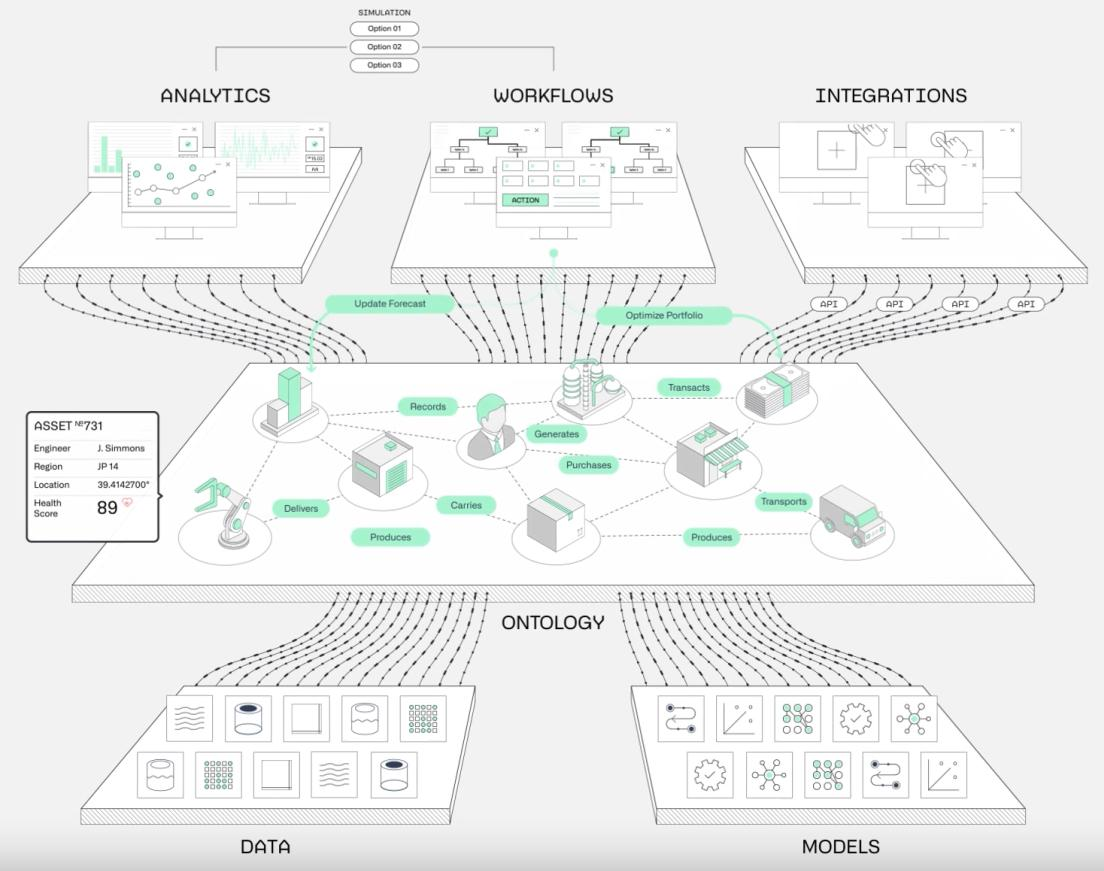 Whether or not an ontology exists changes the entire level of work AI can perform.
The core distinction is simple:
finding information and helping make a decision are two completely different problems.
AI without ontology is closer to an advanced search engine.
AI built on ontology moves through context within the actual workflow.
Take venture capital as an example.
General-purpose AI can answer "What funding round is this startup in?"
Ontology-based AI can answer "If we invest in this company,
what would conflict with our existing portfolio?" The entire level of question changes.
The Difference Between Simple Search
and Context-Based Reasoning

Source: Slack
Let's put the same question to both types of AI:
"Draft a sales email to Munich Re about a marine cargo risk."
General-purpose AI can produce a standard sales email template.
What it can't do is account for how Munich Re currently evaluates that risk, what past deals have looked like, or who the responsible contact is.
Ontology-based AI, on the other hand, can factor in:
- Munich Re's marine cargo underwriting preferences
- Recent market strategy
- Past transaction history
- The assigned underwriter's tendencies
- Existing email communication history
Based on this, it can generate a draft that's actually usable in real business.
Ontology is what makes that difference.
The Reinsurance-Specific Knowledge
Structure Treasurer Is Building

Treasurer has analyzed the actual workflow of reinsurance brokerage
and built a domain ontology on top of it, using it as the core foundation for our AI agent, ARIA.
ARIA hasn't simply learned reinsurance terminology.
It connects risk information, reinsurer-specific underwriting tendencies,
contract and renewal data, and communication history into a single knowledge structure,
and reasons on top of it, functioning much closer to a true AI agent.
When a user asks a question in natural language,
ARIA goes beyond simple search to support real business judgment,
recommending suitable reinsurers for a specific risk or
suggesting the actions needed at renewal time.
This lets practitioners cut down the time spent finding documents,
checking past history, and identifying the right contacts,
freeing them up to focus on higher-value work like client strategy and new business development.
As a result, ARIA functions not as a simple automation tool but as a business partner that improves both a practitioner's productivity and the quality of their decisions.
Want to learn more about ARIA, Treasurer's reinsurance-specific AI agent?
This Isn't Just a Reinsurance Story

Source: Ajou Economy
What matters is that this approach isn't limited to reinsurance.
Every financial institution has its own workflows, decision-making structures, and accumulated domain knowledge.
For AI to deliver real business value, it needs to understand that organization's knowledge structure and operational context.
Venture capital can apply this approach to deal sourcing and portfolio management. Asset managers can apply it to research and investment decisions. Investment banks can apply it to contract review and deal structuring. Insurers can apply it to underwriting and claims. The application differs, but the core principle, domain ontology, stays the same.
Building on the ontology-based AI experience we've validated in reinsurance, Treasurer supports building AI agents optimized for each financial institution's specific operating environment. If you already hold plenty of data but are struggling to put AI to real use, or if general-purpose AI is hitting its limits in practice, get in touch with Treasurer. We'll help you build AI optimized for your business environment, backed by an approach proven in reinsurance.
Closing
AI is evolving beyond a tool that simply summarizes documents into a partner
that works alongside you.
But no matter how capable the underlying model is,
it can't deliver real business value without understanding an industry's concepts, relationships,
and decision-making context.
Conversely, when domain knowledge is systematically structured,
AI can move beyond simple information retrieval to become a tool
that supports work and better decisions.
Domain ontology sits at the center of that shift.
Going forward, how well an industry can structure the data and knowledge it holds will determine how successfully it can put AI to use.
If you're curious about AX trends in the financial industry, real-world AI use cases, and how the financial industry is changing, follow along on the Treasurer blog.
https://play.google.com/store/apps/details?id=com.treasurer.app&hl=ko
📚 Related Reading