Do Higher Interest Rates Always Benefit Banks?
 Hello, this is Treasurer.
On August 27, the Bank of Korea raised its base rate from 2.75% to 3.00%, marking the second consecutive hike.
Higher rates usually mean more expensive borrowing for households and businesses. But for financial companies, especially banks, rate hikes are often seen as positive.
So, do higher interest rates always mean higher bank profits?
Why Raise Rates When the Economy Is Growing?
 Source: 이코노미조선
One of the main reasons central banks raise rates is to control inflation.
Higher borrowing costs can slow consumption and investment, reducing inflationary pressure.
This time, the Bank of Korea also raised its 2026 growth forecast to 3.3%, while core inflation remained elevated.
A relatively resilient economy gives the central bank more room to tighten policy without immediately damaging growth.
Borrowers Feel the Impact First
 Source: 이데일리
A 0.25 percentage-point increase in the base rate does not automatically translate into an identical increase in every loan rate.
Actual lending rates depend on market rates, banks’ funding costs, and borrowers’ credit profiles.
Still, the direction matters.
In July, Korea’s average rate on new household loans reached 4.64%, while mortgage rates rose to 4.48%, even before the latest rate hike was reflected.
For households with floating-rate debt or those taking out new loans, financing costs could therefore increase further.
Do Banks Automatically Earn More?
 Source: 한국경제
Banks earn money by paying interest on deposits and charging a higher rate on loans.
A key measure is Net Interest Margin (NIM), which reflects the difference between what banks earn on interest-bearing assets and what they pay for funding.
If lending rates rise faster than deposit costs, NIM can improve and interest income may increase.
During the first half of 2026, the combined net income of Korea’s five major financial groups reached KRW 13.1 trillion, up 9.7% year-on-year, while their average NIM also improved.
But higher rates do not benefit every bank in the same way.
The Same Rate Environment Can Produce Different Results
Source: KB Think
KB Financial’s group NIM fell from 1.99% to 1.94% in the second quarter.
Despite that, quarterly net income reached a record KRW 1.99 trillion, supported partly by stronger non-interest income from businesses such as securities and asset management.
Hana Financial, meanwhile, saw its NIM rise from 1.82% to 1.88%, but provisions and foreign-exchange-related losses also affected earnings.
This shows why bank profitability cannot be explained by interest rates alone.
Investors Need to Look Beyond the Base Rate
 Source: 한겨례
When rates rise, deposit costs can also increase. Loan demand may weaken, while higher debt-servicing burdens can lead to more delinquencies and higher provisions.
At the same time, stronger markets can increase fee income from securities, wealth management, and other non-banking businesses.
So instead of assuming that “higher rates are good for bank stocks,” investors need to look at NIM, loan growth, credit costs, non-interest income, and shareholder returns together.
Comparing Financial Groups with AlphaLenz
The base rate is the same macroeconomic environment for every bank.
What differs is how each financial group converts that environment into earnings.
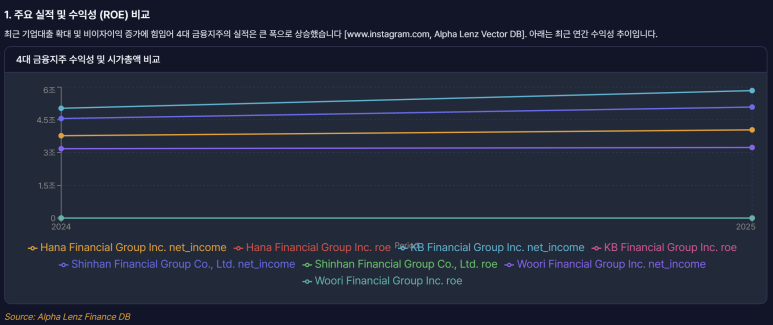
 AlphaLenz allows investors to compare KB Financial, Shinhan Financial, Hana Financial, and Woori Financial across net income, ROE, NIM, CET1 capital ratios, and shareholder-return policies.
This helps show which institutions are actually growing earnings, how their interest and non-interest income are changing, and how excess capital is being returned to shareholders.
Rather than looking only at whether rates are rising or falling, the more important question is:
How is each financial company turning the same interest-rate environment into actual performance?